Software for home building contracts
You run the site.
The contract runs itself.
Building contracts are full of deadlines — for variations, payment claims and extensions of time. Miss one and you can lose money you’re owed, even when you’re in the right. eSiteOffice writes the paperwork, sends it, and reminds you before every deadline.
What’s your role on the job?
Every variation has a deadline.
So does every payment claim and extension of time, on every job you run. The claims you lose usually aren’t the ones you argued about — they’re the ones where the paperwork went in late.
For builders — start here →Variation notice
In writing and priced, before you start the work — not texted afterwards.
Payment schedule
When a trade sends you a claim, you have 10 business days to reply in writing, or you owe the full amount.
A reply to your claim
If the client doesn’t reply in time, you’re owed the full amount.
Every stage of a building job has deadlines.
From signing the contract to the final handover, there are dates you have to meet. Most people keep them in their head or a diary — and that’s where disputes usually start.
Signing the contract
- Deposit capped at 10%
- Home warranty insurance before any payment
- Licence checked and on file
Before building starts
- Approvals in place, certifier appointed
- Insurances current
- Building schedule issued
During construction
- Variations in writing before the work
- Payment claims and schedules
- Notices asking for more time
Handover and defects
- Notice that the work is finished
- Period for fixing defects
- Final claim and money held back
If there’s a dispute
- Deadlines to apply for adjudication
- Notices before ending a contract
- A complete record of what happened, and when
What it looks like
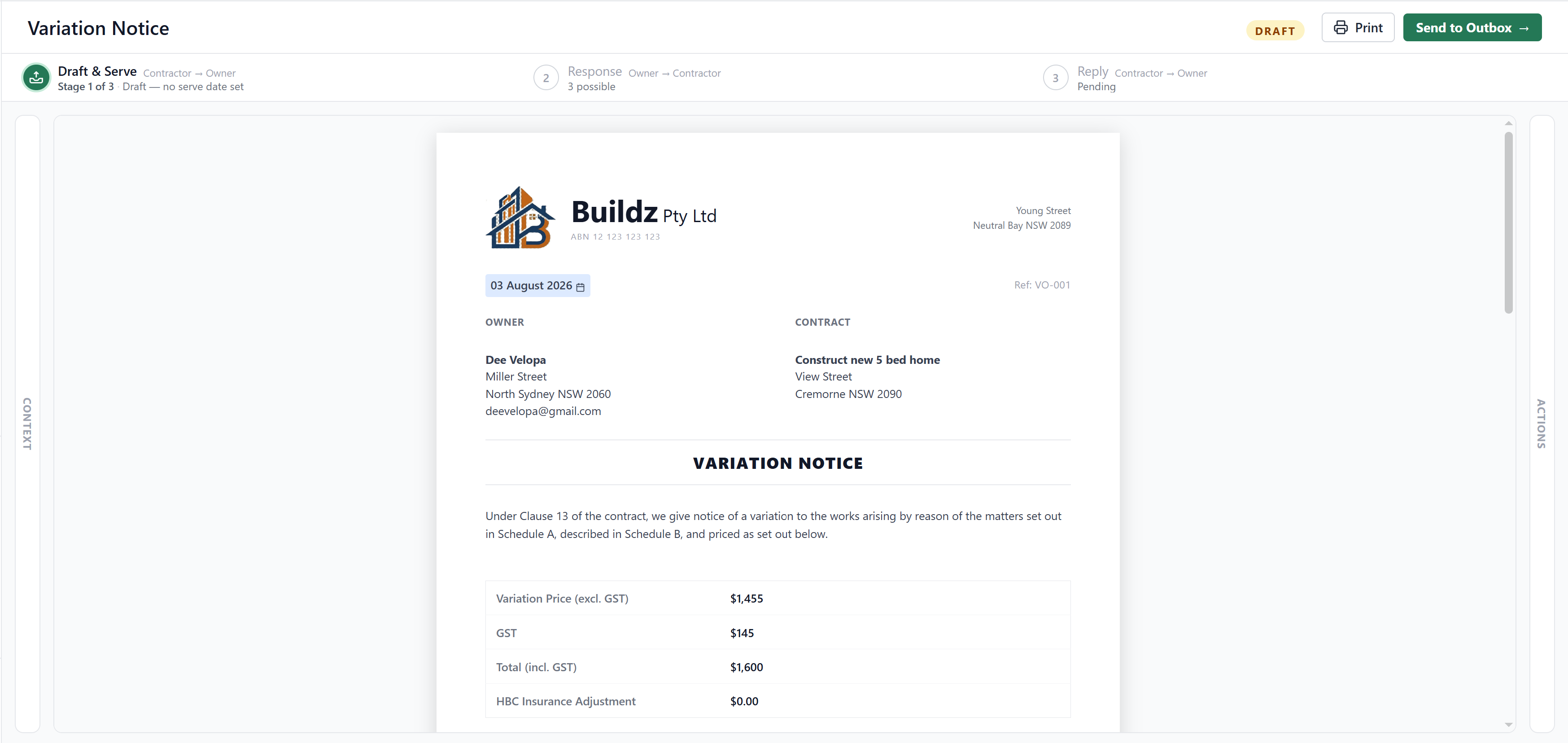
A variation, done properly.
This is a variation notice in eSiteOffice — priced, with its schedules attached, and ready to send.
The bar across the top shows each step and its deadline: you send it, they respond, you reply. eSiteOffice tracks each one.
Free guides
Free guides
Straightforward answers to common questions. Free, no sign-up.
Owner-buildersPermits, loans, courses, and pricing the trades
- Owner-building in NSW — start hereThe complete picture: thresholds, what you take on, where to go next
- Should I owner-build at all?The margin, and the legal position that comes with it
- Why do tradies avoid owner-builders?Their own reasons — and the exception they all mention
- Why will the bank lend me less?Lower caps, stage-by-stage scrutiny, and what they ask for
- What do I need before I can apply?Every requirement, in the order the application demands
- Which course do I have to do?Every approved provider, prices verified, none paid to appear
- A trade has served you a payment claim10 business days to answer in writing — say nothing and you owe the lot
- Work out your reply deadlineFree. The dates for one claim, on the Act’s own business-day count
BuildersGetting paid, and the deadlines that end a claim
- For builders — start hereYou claim up and get claimed on down: the obligations both ways
- What is a payment claim?The three things it must say — and what silence costs them
- A claim has landed on you10 business days or fewer, and what the reply must say
- I served a claim — the timetableFree. Their deadline to reply, when payment falls due, how long to adjudicate
- One landed on me — my deadlineFree. The last day you can serve a payment schedule, on the Act’s own count
Trades & subcontractorsPayment claims, schedules and adjudication
- For trades — start hereLast paid, first squeezed — and the strongest powers are yours
- The builder hasn’t paid meWhat you can actually do, and the deadlines that decide it
- What is a payment claim?The one line that arms everything — and how to serve it
- HBCF — what you must hand overBefore you can take a dollar over $20,000
- I served a claim — the timetableFree. Their deadline to reply, when payment falls due, how long to adjudicate
- One landed on me — my deadlineFree. The last day you can serve a payment schedule, on the Act’s own count
Owners & strataBefore you pay, defects, insurance and common property
- For owners — start hereWhat your builder owes you, and when
- For strata managers — start hereMaintenance and capital works are building work, and your legal exposure comes through the owners corporation’s delegation to you
- Before you pay a centContract, licence, insurance certificate, 10% deposit cap
- Something’s wrong with the workThree separate rights, not one — and how long each lasts
- What is HBCF, and who gives it to me?The certificate that must exist before money moves
- A payment claim has landed on you10 business days to answer in writing — and your contract may give you fewer
- What makes it a payment claim at all?The three things it must say — and what it starts the day it arrives
- Work out your reply deadlineFree. The dates for one claim, on the Act’s own business-day count
Opens October
Register interest
eSiteOffice prepares the notices, claims and certificates your contract needs, sends them with proof, and reminds you before every deadline — on all your jobs. It opens in October.
- Be one of the first to use it.
- Keep the launch price for as long as you stay.
- Help decide what we build next.
Get on the list
Three quick questions.