This doesn’t replace your strata software
Nothing here touches the strata roll, levies, accounts, by-laws or meetings. StrataMax, MYBOS and Urbanise handle those, and there’s nothing to move across. eSiteOffice covers what happens when a scheme hires a builder: the contract, the notices, the deadlines and the record.
The hard part is keeping up
You’re not managing one contract — you’re managing one on every scheme with work under way. A variation on Tuesday. A payment claim on Thursday with 10 business days to reply. A defect that must be reported in writing, with proof. A committee in March asking what happened in October.
Every document under a building contract has to be written the way the contract requires, sent in a way you can prove, and tracked for the deadline it starts. eSiteOffice does all three, and shows every obligation on each scheme in one list: what’s due, who owes it, and when.
What applies once it’s building work
The owners corporation is the client — the same position a homeowner is in, with more money involved. Most of the work lands on your desk rather than the committee’s.
A written contract is required (amounts include GST). It’s the contractor’s legal duty to provide it. Starting without one is an offence by them, and can stop them suing for payment.
The contractor must give the owners corporation a home warranty insurance certificate before taking any money, including the deposit.
A licensed contractor, licensed for that type of work. Check at verify.licence.nsw.gov.au.
The Security of Payment Act applies. A builder’s payment claim gives the scheme 10 business days to reply (fewer if the contract says so). No reply means the full amount is payable, with no chance to dispute the work. What to do when a claim arrives →
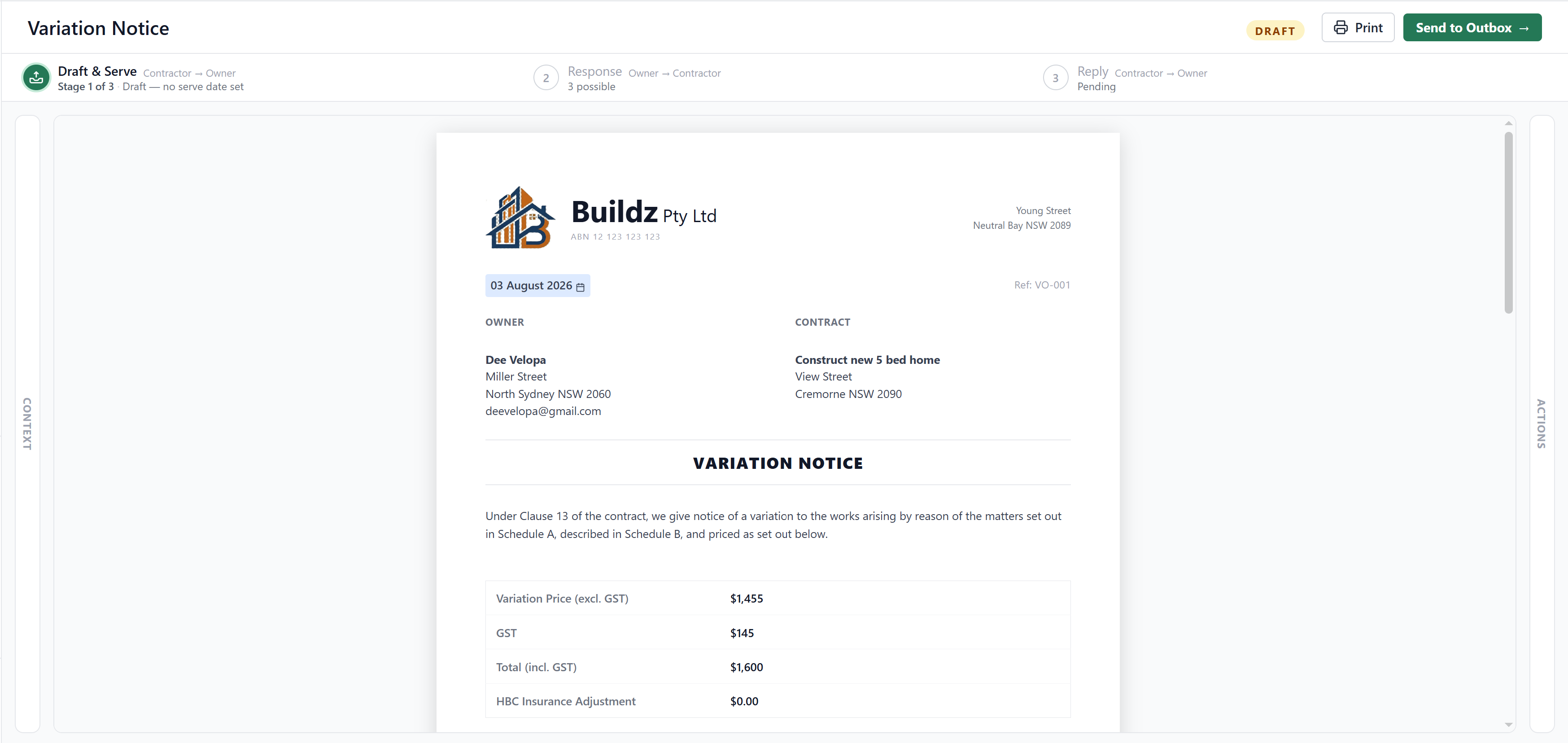
Variations in writing, signed by both sides, before the work starts. This is the biggest source of avoidable cost on remedial jobs.
The statutory warranties belong to the owners corporation: 6 years for major defects, 2 years for others, from completion. Plus a separate legal duty of care, and a 10-year overall limit. In detail →
The high-rise exemption doesn’t cover repairs
Committees often think home warranty insurance doesn’t apply because their building is over three storeys, and contractors sometimes say so too. That exemption only covers building new multi-unit buildings over 3 storeys.
It doesn’t cover renovation, alteration, repairs or maintenance — including work on the common property of a high-rise. Work over $20,000 must be insured, however many storeys the building has. So a twenty-storey building spending $400,000 on repairs is in the same position as a homeowner: the certificate comes before any payment. Check it at hbccheck.nsw.gov.au before releasing the deposit.
Who has a contract with whom
A real building contract. The owners corporation is the client, holds the warranties, and carries the legal and financial responsibility.
A strata management agreement. You act as the owners corporation’s agent — signing, paying and sending notices for it under delegated authority.
No contract at all. You pass on instructions; you aren’t a party to the building contract.
What that means in practice: an individual lot owner has no right to instruct the builder. Instructions come from the owners corporation, through the committee or an appointed superintendent. And because you have no contract with the builder, everything depends on instructions and notices actually reaching them — in writing, with proof.
Your legal exposure comes from the delegation, not the builder
If the builder does poor work, walks off the job or goes broke, that isn’t your liability. You have no contract with them, and the workmanship was never yours to guarantee.
The delegation is different. Anything you do under it has the same effect as if the owners corporation did it (s 53). If a breach of the owners corporation’s duty would be an offence, you commit the offence instead of the owners corporation while the delegation is in force (s 57(1)).
Your defence is narrow: you must show the owners corporation caused the breach and that you took all reasonable steps to prevent it (s 57(1A)). In practice that means records. The law already requires them: when you carry out a function for the owners corporation, you must record it immediately — what you did and how — and give the owners corporation a copy every 6 months (s 55).
Since 2025, someone can ask to see those records
The Strata Schemes Legislation Amendment Act 2025 gave the Secretary power to enter, inspect, demand records, and give directions with a penalty for each day they’re not followed (s 188Q). The Secretary can also ask the Tribunal to order a breach of the maintenance duty (s 106) fixed, without proving damage is likely (s 188V).
So the question is rarely whether the work was done. It’s which certificate arrived before which payment, which notice was sent on what day, what the owners corporation approved and when. That record is easy to keep as the work happens, and hard to piece together two years later.
When the committee changes
Every year or two, the people who agreed the scope leave, and a new committee asks what was decided and whether a defect was ever reported. Today those answers sit in inboxes and old email threads. One record per scheme, built as the job runs, answers them — and makes the six-monthly copy under s 55 quick to produce.
“Can’t the committee just run it?”
It comes up on most remedial projects, usually to save money: the committee manages the trades directly, or a member who’s a builder runs it as a favour. For a house, that’s called owner-building and needs a permit. An owners corporation can’t get one.
What the scheme loses if the job is run informally
The insurance is gone. Home warranty insurance is only issued to licensed contractors. No licence, no certificate — so there’s nothing to fall back on if the work fails or the trade disappears.
The statutory warranties are not gone, despite what’s often said. They’re built into every contract for residential building work, including one by a person who should have held a licence and didn’t.
But an unlicensed person can’t enforce the contract or recover payment, while still being liable for their own breaches. That leaves the scheme’s money with someone who has no insurer and every reason to walk away.
And a member who instructs trades without a committee resolution is acting outside their authority — one of the few things that removes the personal protection committee members otherwise have for acts done in good faith (s 260).
Apartment buildings: a second set of rules
On class 2 buildings, the Design and Building Practitioners Act 2020 adds design and declaration requirements on top of the licence — and they apply to repair work on existing buildings, not just new ones.
Class 2 — multi-storey apartment buildings where people live above or below each other, and mixed-use buildings with a class 2 part. Not every scheme is class 2: side-by-side villas or townhouses with nobody above or below are generally class 1a and outside this regime. The Home Building Act still applies either way.
A registered design practitioner prepares and declares the designs, which are lodged on the NSW Planning Portal before work starts.
A registered building practitioner does the work, following the declared designs. A licensed builder alone isn’t enough.
Exempt development under the codes, and some narrow carve-outs. Emergency repairs have their own path: make the building safe, then declare it.
Before a quote goes to the committee: on a class 2 building, a structural or waterproofing quote with no designer named and no designs mentioned is a warning sign — the job can’t lawfully be built from it. Ask for both registration numbers, check them on the public register, and get the design declarations before the first payment.
When defects appear, the scheme must act reasonably
An owners corporation that suffers a loss must act reasonably to recover it. It can’t recover losses caused by its own unreasonable conduct.
So unless there are good reasons not to, the scheme should tell the builder about the defects in writing and give them a real chance to fix them, using a scope set by independent experts. A committee that has lost confidence often wants the builder gone by Friday. Doing that without good reason can reduce the scheme’s own claim. The safe path: notify properly, document the expert scope, give the builder the chance, and record what happens and when.
Good practice on a remedial project
- Treat it as a building contract from day one, not a purchase order. Written contract, licence checked, insurance certificate before any payment.
- Nobody in the scheme acts as the builder. The work goes to a licensed contractor — and on a class 2 building, a registered building practitioner working to declared designs.
- One channel for instructions. Decided by the committee, sent by you or the superintendent, received by the builder, recorded. No verbal directions from individual owners on site.
- Variations in writing before the work: what’s changing, the price, GST, and the effect on the finish date.
- Payments match the work actually done, and the reply deadline is noted the day a claim arrives.
- Every defect reported in writing, with the expert scope, and the response recorded.
- One record per scheme, ready when the committee changes, the agency changes, or a lawyer asks.
Every change in writing, before it’s built. On every scheme.
eSiteOffice writes each notice the way the contract requires, sends it with proof, tracks every deadline on every scheme, and keeps one record per scheme.
Opens in October. Register to be one of the first to use it and keep the launch price for as long as you stay.